
What Should You Look for in a Secondary Sales Tracking Software
Discover the key features to look for in secondary sales tracking software for FMCG. Learn how the right platform drives visibility, accuracy, and growth.

Share Article:
In the fast-paced FMCG industry, technology now drives how efficiently products reach consumers. Beyond just sending stock out, brands need connected systems that link distributors and retailers with complete visibility. Manual tracking or isolated spreadsheets can no longer keep up with today's dynamic markets. This is why choosing the right software is crucial for FMCG businesses, which ensures data accuracy, operational speed, and smarter execution.
This blog post will guide you through all the features an effective secondary sales management software should have to help FMCG businesses drive visibility, accuracy, and growth.
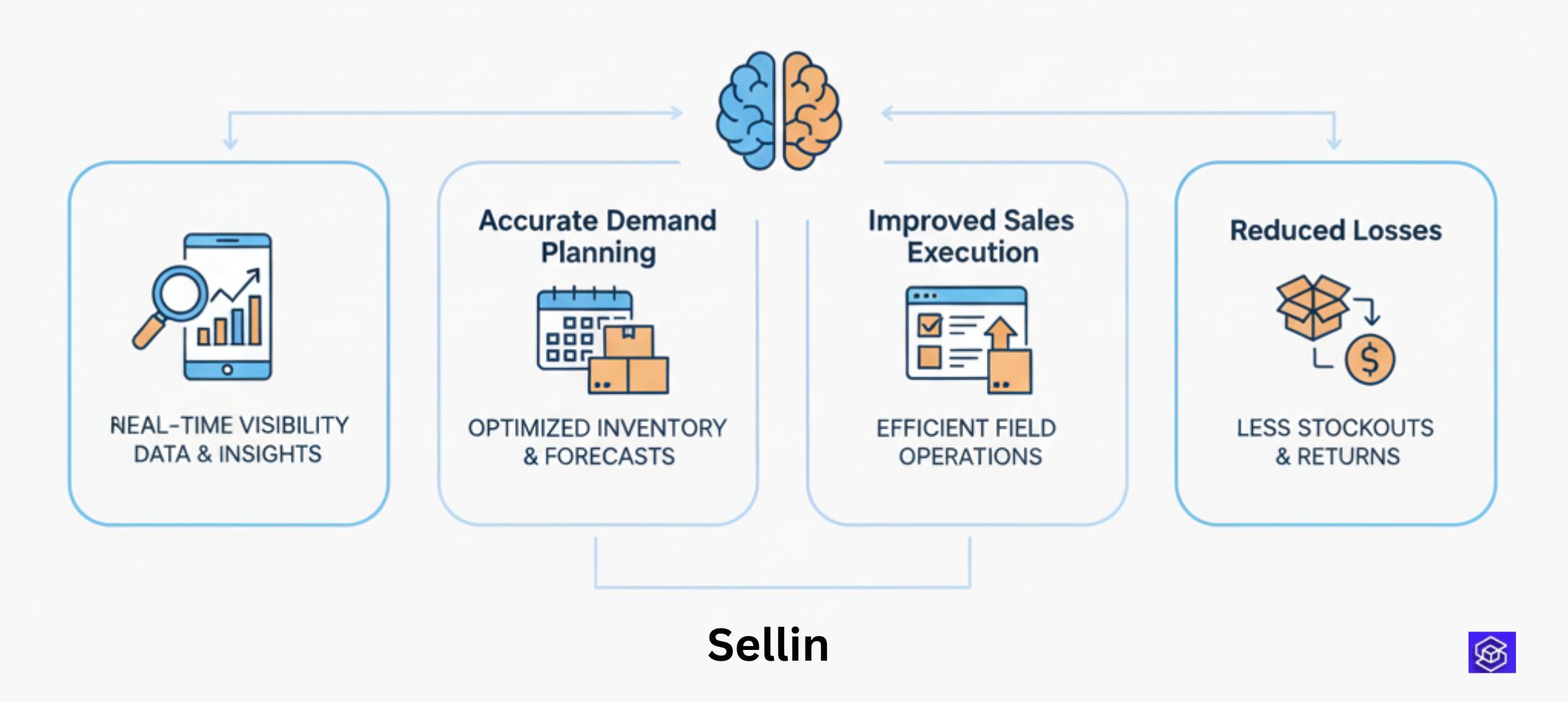
This is what Sellin does for FMCGs to manage their secondary sales effectively:
Features that Define a Strong Secondary Sales Management Software
Here are the key features and capabilities which every FMCG business should look for when choosing a software for secondary sales management.
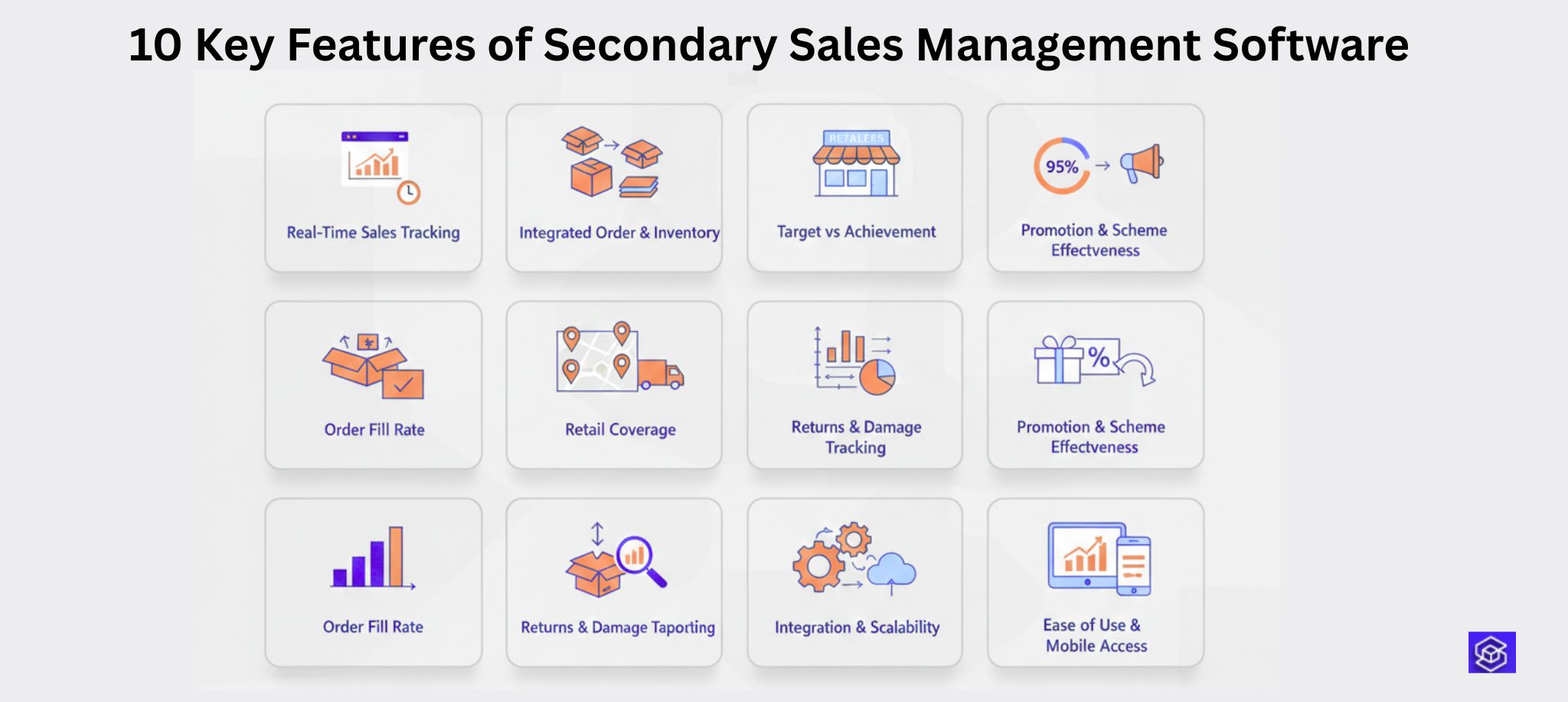
1. Real-Time Secondary Sales Tracking
In a fast-moving consumer market, data delay is a lost opportunity. Your secondary sales tracking software should provide a live view of what is selling, where it is selling, and at what pace. Real-time tracking ensures you are not relying solely on primary sales figures, which often paint an incomplete picture.
By capturing secondary data directly from distributors and retailers, you gain a true understanding of consumer demand. It becomes easier to forecast replenishment needs, plan promotions, and avoid the costly issue of pushing stock into a saturated market.
Sellin provides real-time dashboards that show secondary sales movement across distributors and retailers for clear market visibility.
2. Integrated Order and Inventory Management
A strong secondary sales solution should bring complete transparency into distributor and retail stock. It should tell you how much inventory sits at each level, what needs to be replenished, and where a slow-moving stock exists.
Integrated order management streamlines processes for sales teams and distributors. Orders can be placed, approved, and fulfilled through the same system, reducing manual errors and delays. With live visibility into stock-in-hand and reorder cycles, your supply chain becomes more responsive and less prone to disruption.
Sellin combines order booking with live distributor inventory visibility to help teams monitor stock movement and replenishment cycles.
3. Retail Coverage and Outlet Performance
The strength of an FMCG business lies in its deep penetration of the retail landscape. A secondary sales software should help you track your retail footprint in detail. Through geo-tagged outlet mapping and field-visit tracking, you can monitor active outlets, identify coverage gaps, and plan expansion into untapped areas.
The software should also measure outlet productivity by tracking average sales per store. This gives you clarity on which outlets are driving growth and which need activation support or better trade terms.
Sellin uses geo area mapping and territory tools and tracks outlet coverage to monitor sales activity at the retail level. It helps teams improve on-ground reach and execution.
4. Target vs. Achievement Visibility
Targets drive performance, but only when they are tied to real secondary movement. A powerful software must allow you to track daily or weekly progress against targets for each salesperson, region, and SKU.
When you can see exactly where performance gaps exist, managers can step in early with corrective actions. Dynamic dashboards make it easy to compare planned goals with actual achievements and to celebrate teams who consistently deliver results.
Sellin enables target setting by role, region, and SKU, with dashboards showing actual achievement against planned goals.
5. Promotion and Scheme Effectiveness
Trade promotions and schemes form a large share of FMCG spending. Yet many companies struggle to measure whether these investments actually translate into incremental sales.
Your secondary sales software should link promotional data with sales outcomes. It should show which schemes gained the highest retailer participation, how much lift they generated, and what the return on investment looks like. This insight enables teams to refine promotional strategies and allocate budgets where they have the most impact.
Sellin tracks scheme execution by linking active promotions with order booking and fulfillment data, helping teams monitor distributor and retailer participation on the ground.
6. Order Fill Rate and Service Quality
Retailer satisfaction depends on the reliability of deliveries. The software should help track order accuracy, delivery timelines, and fulfillment status for every distributor.
By comparing ordered versus delivered quantities, businesses can identify bottlenecks and prevent stockouts. Consistently high fill rates strengthen retailer trust and ensure smoother market availability, which ultimately supports steady sales growth.
Sellin tracks order booking versus order execution to give visibility into fulfillment gaps and delivery completion.
7. Returns and Damage Tracking
Returns are a reality in FMCG operations, but they also reveal valuable insights about product handling and market performance. The right system helps you identify patterns in sales returns or damages through automated tracking and dashboards.
When you can view return ratios, regional trends, or specific product issues, it becomes easier to implement preventive measures. Improved packaging, better stock rotation, or enhanced logistics practices can directly reduce losses and improve profitability
Sellin captures order booking and delivery execution through its mobile app, enabling teams to identify fulfillment gaps and recurring execution issues.
8. Data-Driven Insights and Reporting
Data without insight holds limited value. Your software should not just collect information but transform it into meaningful reports and visual dashboards that empower decision-making.
Customizable dashboards make it easier for different teams to view the metrics most relevant to them. Leadership teams can focus on revenue growth and territory performance, while field managers can track outlet activity or scheme execution.
Sellin converts field and sales data into role-based dashboards and reports for faster operational and strategic decisions.
9. Integration and Scalability
FMCG operations rely on multiple systems, including ERP, CRM, and DMS. A capable secondary sales management platform must integrate smoothly with these existing tools. It should enable seamless data exchange across departments, ensuring everyone uses the same source of truth.
Scalability is equally important. As your business expands across territories and product categories, the software should easily accommodate more users, data, and workflows without performance issues.
Sellin supports API-based integration with ERP and other systems and scales across users, territories, and product lines.
10. Ease of Use and Mobile Accessibility
Sales teams spend most of their time in the field, not behind a desk. The software should be easy to use and accessible through mobile applications with offline capabilities.
Field teams must be able to record orders, update outlet data, and check their targets instantly. When tools are intuitive and responsive, adoption increases and data accuracy improves significantly.
Sellin offers a mobile-first application with offline capabilities, enabling field teams to work efficiently on the go.
Is Sellin the Best Secondary Sales Management Software?
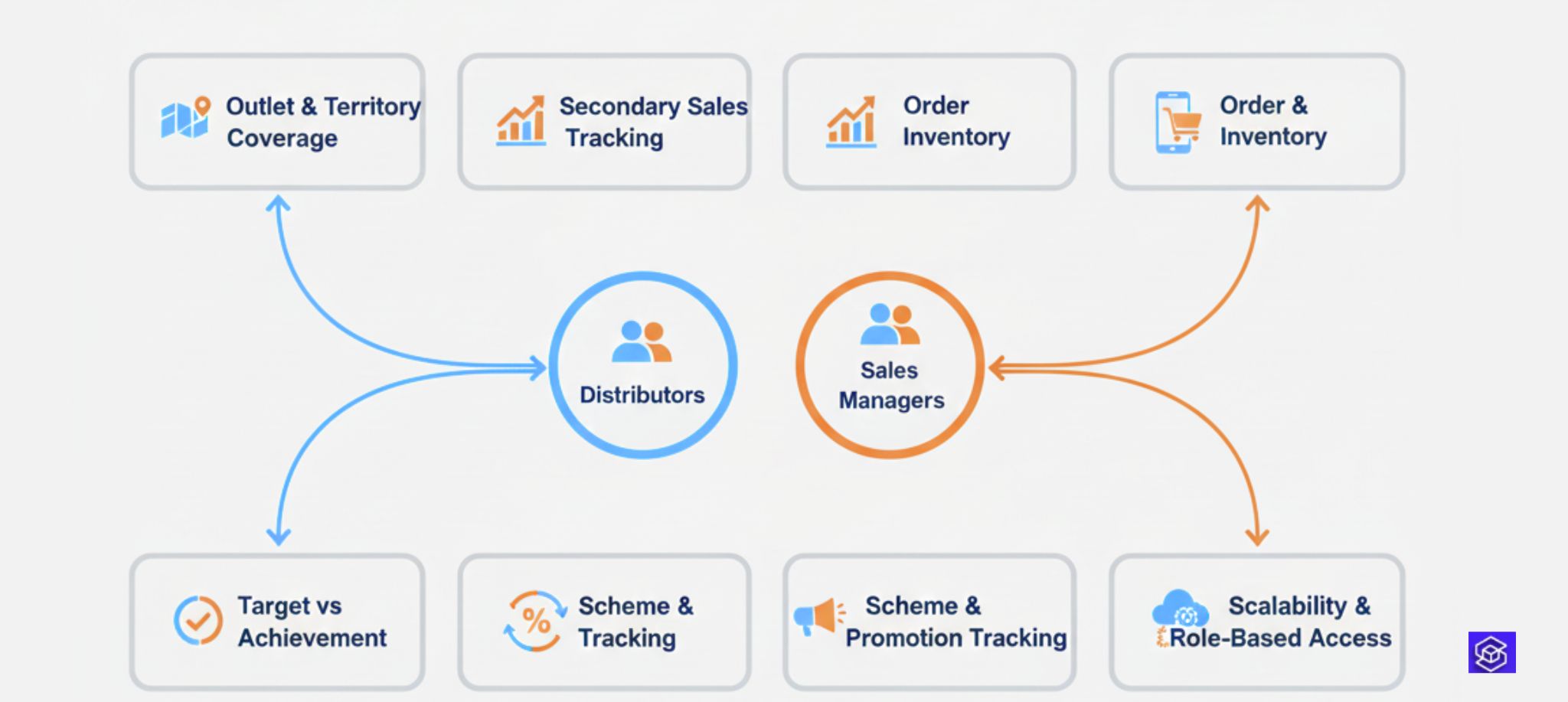
Yes Sellin is the best software for secondary sales management. It consists of all the features which FMCGs require to manage secondary sales effectively. With real-time dashboards, live tracking and easy integration, it empowers leaders to turn field data into an actionable strategy. In today's competitive market, that capability makes all the difference between reacting to problems and staying ahead of them.
Choosing the right secondary sales management software is not just about automation. It is about building visibility, agility, and trust across your distribution network. When you can see what is truly happening in the market, you can respond faster, serve the market better, and grow more sustainably.