
Why Customization Matters in Distribution Management
Learn why one size does not fit all in distribution and how customization improves stock flow, market coverage, and overall sales performance.

Share Article:
In distribution management, one size rarely fits all. Studies show that roughly 20% of SKUs account for 80% of sales, yet many companies apply the same routes, targets, and expectations everywhere. Retailer behavior and product demand vary widely, and ignoring these differences leads to missed opportunities. This is where customization turns insight into action. It enables teams execute smarter, adapt faster, and drive growth.
This blog explains why customization matters, how it alters the way sales managers and executives work, and why it directly links to revenue acceleration and market expansion.
The Need for Flexible Distribution Strategies
Distribution is becoming more complex every year. Markets shift quickly, order frequency fluctuates, new SKUs enter the chain, and field execution demands sharper control. Yet many FMCG and retail companies still operate with one standard method for every region. They plan the same routes, apply the same targets, and expect identical field efficiency everywhere. Reality is different.
Retailer behavior changes by geography.
Product offtake varies by season.
One city might move stock every two days while another orders only once a week.
This is where customization becomes the foundation of modern distribution success. When a distribution process adapts to the market instead of forcing the market to adapt to the process, performance improves and bottlenecks reduce. Customization gives teams room to adjust strategy, track execution the way they want, and scale without losing control.
One Market but Many Realities Across It
A national map looks unified but operations inside it do not behave in the same pattern. Eight stores on one street might require daily visits while twenty villages across a district order once a week. Ice cream distributors operate on temperature urgency. Pharmaceutical distributors operate on expiry sensitivity. Beverages move fastest in summer while cooking oil demand remains stable through the year.
Customization matters because distribution never follows a single rule. When organizations try to standardize everything without flexibility, they ignore the unique drivers that shape genuine sales velocity. A field plan can miss important stores. A target can exceed market capacity. A route can consume hours without achieving meaningful coverage. Customization corrects these problems by allowing sales teams to adjust structure according to ground reality instead of theoretical planning.
What are the Benefits of Customization for Distribution Teams?
When distribution management systems allow customization, teams gain full control instead of constantly reacting to problems. It brings real and immediate benefits, a few of them are discussed below:
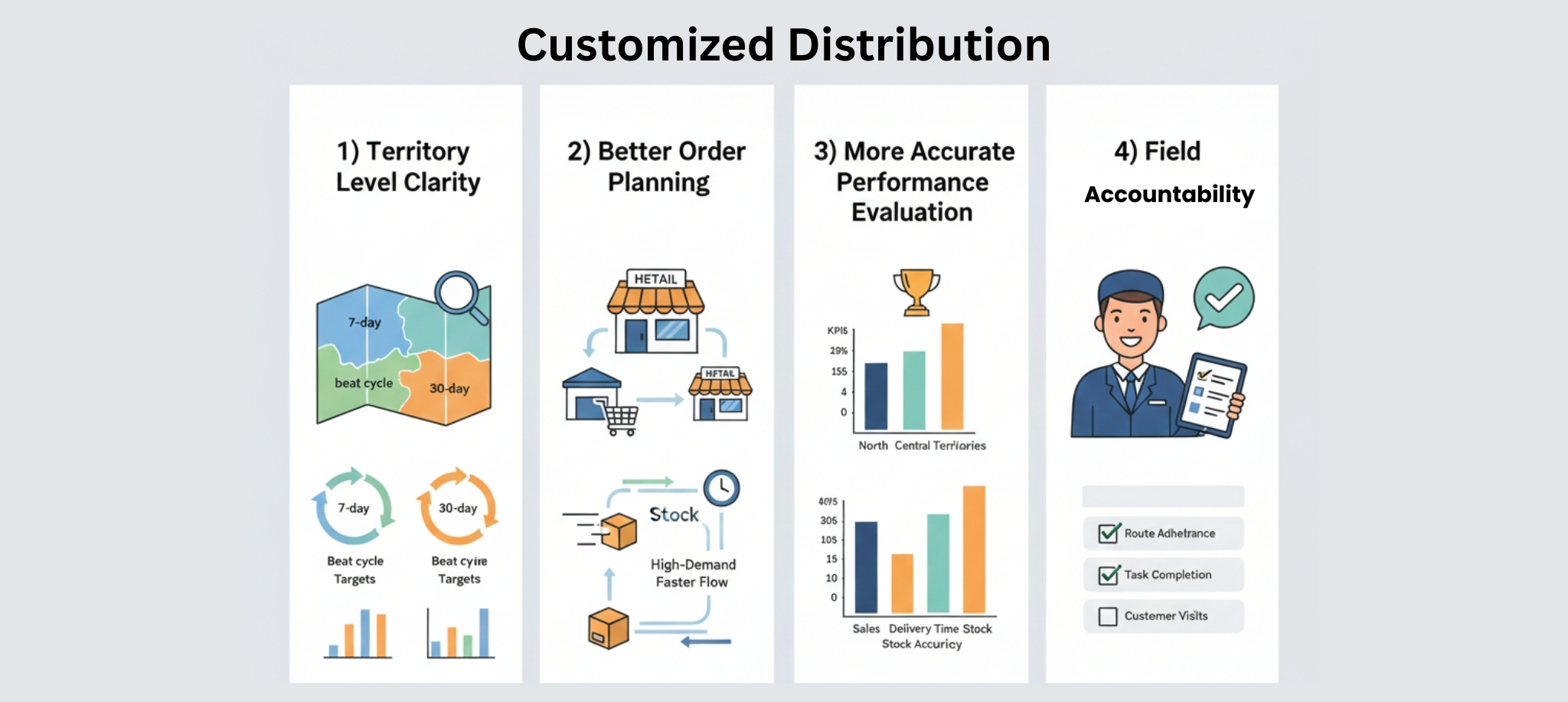
1. Territory Level Clarity
Managers can assign different beat cycles, visit frequency, town level targets, and assortment priorities based on market type instead of applying one format everywhere.
2. Better Order Planning
Distributors can align stock allocation according to store throughput rather than simple averages. Products that move faster get replenished faster.
3. More Accurate Performance Evaluation
Instead of generic KPIs, each territory can be evaluated based on expected behavior. Urban KPIs differ from rural KPIs. Seasonal SKUs differ from core SKUs.
4. Field Accountability
Sales reps understand what success looks like in their environment. They execute with direction, not confusion.
Customization gives managers both control and confidence. It gives leadership insight that matches reality. It removes standardization pressure and replaces it with intelligent distribution design.
When Does One System Work but One Size Not?
Many businesses invest in a distribution management system but often fail to configure it according to how their market actually behaves. Instead of tracking what truly drives sell-through, their focus goes to surface-level metrics. Visits are recorded, yet product placement remains unchecked. Orders are logged, yet potential stores stay unidentified. Revenue is monitored at a total level, but SKU-level performance , where margin decisions are made are often remain unseen. Data exists, but the outcome remains limited because the system does not align with execution realities. Let me help you understand, just imagine:
A high frequency item may need replenishment every second day while a slow mover needs monitoring once a week
A new product might need visibility KPIs instead of revenue KPIs
A promotional period needs daily reporting while a stable period needs summary only
Here the major mistake is not the lack of effort but of alignment. This is why a customizable distribution management system is not an advanced feature but a requirement. It enables each data point to be tracked according to selling stage, push period, retailer behavior, and SKU maturity. The outcome is clearer execution and forecasting based on what is happening rather than what is assumed.
How Customization Improves Field Execution Quality
Field execution depends on clarity. A sales representative delivers their best work when tools and targets match the environment where they operate. Customization gives them that clarity. It defines how many outlets to visit, what products to push, how much stock to sell, and what coverage rhythm to follow.
Custom execution elements that sales teams customize most are following:
Frequency: Daily, alternate, or weekly coverage based on store throughput.
SKU priority: Push core SKUs in old markets, push new launches in developing ones.
Route planning: Shortest time routes in cities, geography based routes in rural spread.
KPI mapping: Different markets require different evaluation standards.
When execution is customized, productivity does not come from pressure but from structure. It becomes easy to measure performance because the parameters are relevant and fair. It becomes easier to scale because the system grows with discipline, not chaos.
Customization is No Longer an Option, But a Competitive Edge
Markets are expanding faster than traditional structures can handle. Brands launch products quicker. Retailers demand credit terms. Customers expect instant service. Without customization, distribution remains slow, rigid, and expensive. With customization, distribution becomes responsive, intelligent, and scalable.
Companies that customize distribution do not just run their network. They understand it. They improve it. And they grow through it.
How Sellin Supports Customized Distribution Management
Sellin does not replace your structure. It adapts to it. It allows teams to define KPIs, coverage rhythm, reporting format, SKU priorities, territory wise targets, and distributor level stock visibility the way they want. Managers track execution in detail. Executives watch trends and financial direction. Both access the same data but each receives it in a view that supports the decisions they must take.
Sellin strengthens distribution by offering
Territory specific setup and objectives: Each region runs based on its reality, not a standard template.
Real time secondary sales visibility: Distributors do not operate in the dark and neither does management.
Custom KPI tracking for field performance: Measure what matters based on market pattern and brand objective.
Intelligent reporting and dashboards: Managers handle the micro. Executives handle the macro. No overlap. No confusion.
Customization is not just a feature inside Sellin. It is the outcome it delivers. Teams execute better. Leaders forecast better. The network grows with clarity instead of friction.