
Digital Territory Mapping vs. Manual Assignments: Which Drives More Revenue?
Discover why territory mapping outperforms manual assignments for revenue, efficiency, and accountability. Learn which method drives consistent growth.

Share Article:
Imagine two sales teams. One relies on manually assigned zones, the other uses data-driven territory mapping. Studies show that companies optimizing sales territories can enhance productivity by 10–20% by aligning efforts with high-potential customers, reducing travel, and minimizing administrative tasks. While results vary, research clearly favors mapping over manual assignment.
This article explores why territory mapping delivers higher revenue, better coverage, and stronger accountability. We will examine risks of manual methods, the benefits of structured territories, and actionable steps to transform field operations effectively.
What is Territory Mapping and Manual Assignment? - A Quick Overview
Territory Mapping divides markets into zones based on customer clusters, sales potential, and travel distance. Each zone is assigned to a specific sales rep. Managers gain visibility through digital dashboards, making coverage, goals, and adjustments easier. This method ensures clarity, accountability, and balanced workloads.
Manual Assignment, on the other hand, relies mostly on intuition or traditional methods. Managers assign areas based on personal judgment, familiarity, or legacy divisions that may no longer reflect current realities. Over time, this leads to uneven workloads, missed opportunities, and limited performance tracking.
The key difference lies in control. Mapping provides actionable insights, while manual methods leave much to chance, affecting revenue potential and operational efficiency.
Why are many Teams Still Sticking with Manual Assignments?
Manual assignments remain common because teams feel familiar and flexible. Small teams may lack tools or data to support mapping. Managers trust local knowledge and assume it ensures coverage. Despite the familiarity, manual assignments carry hidden risks that can quietly reduce efficiency and revenue:
Coverage gaps emerge over time
Some reps handle too much, while others handle too little
Performance tracking becomes difficult
Disputes over account ownership arise
As teams grow or markets expand, manual methods struggle to keep pace, reducing efficiency and revenue.
Since these challenges usually build up quietly, companies often shift to a digital mapping solution to bring accuracy and consistency. Sellin helps you bridge exactly this gap by removing the friction of managing territories manually. It gives teams ready-made geo areas, updated outlet lists, and simple assignment tools. It helps even small teams to shift from intuition-based planning to organized, data-backed coverage.
How Data-Driven Territory Planning Outperforms Manual Allocation?
Structured territory planning provides advantages that manual assignments cannot match.
Sales teams perform better with data-driven zones. Each representative knows their exact territory, minimizing missed or duplicated visits. Workloads balance naturally, while optimized routes save travel time and costs. Visibility allows managers to monitor performance in real time, rewarding top performers and identifying underperforming zones. Clear territory structure turns daily effort into predictable results. Teams focus on selling, and managers make informed decisions.
Translating these advantages into everyday field activity requires a system that can manage zones, visits, and travel in real time. Sellin is designed to support that shift effectively. It highlights duplicate visits, missed outlets, and route inefficiencies instantly. Its mapping engine builds fair, optimized territories that improve daily productivity without additional staff.
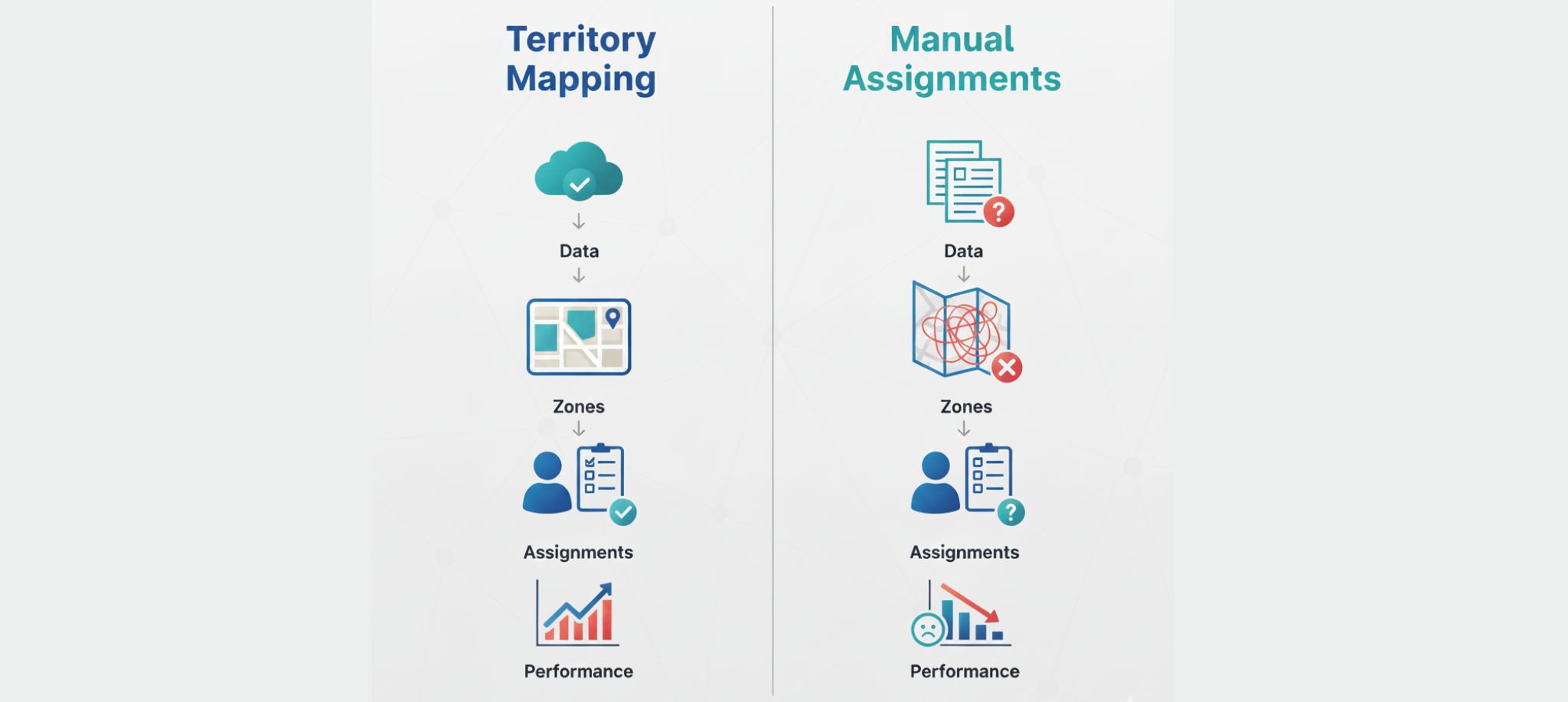
Key Benefits of Territory Mapping Over Manual Assignments with Sellin
Before exploring exceptions where manual assignment may work, it is important to highlight the advantages businesses gain from structured territory mapping. Sellin helps you get the following benefits which directly impact efficiency, coverage, accountability, and revenue outcomes.
Balanced Workload Across Teams Every sales representative receives a fair number of accounts, preventing overburdening and underutilization.
Complete Market Coverage Structured territories reduce gaps and overlaps, ensuring every outlet receives attention.
Time and Cost Efficiency Optimized routes save travel time and reduce operational costs, letting teams focus on selling.
Enhanced Accountability Managers gain clear visibility of activities and results, making performance tracking accurate and fair.
Predictable Revenue Growth Data-backed territories turn effort into measurable results, unlike the uncertainty of manual assignments.
Adaptability for Market Changes Territories can scale easily with market expansion, new outlets, or changes in customer density.
These benefits become even more practical when supported by a platform that brings structure, clarity, and traceability to field teams. Sellin plays a key role here.
Feature | Territory Mapping | Manual Assignments |
Basis for zones | Data, potential, distances | Intuition, legacy maps |
Workload balance | Balanced across sales representatives | Uneven often |
Coverage gaps | Minimized | Common |
Change adaptation | Easier | Slower |
Accountability | Transparent | Harder to trace |
Revenue impact | Predictable lift | Unpredictable |
When Manual Assignments Work and Where They Fall Short
Manual assignment makes sense only in very limited cases. Small teams operating in compact areas, where customer locations are few and predictable, can often manage without digital tools. In such cases, supervisors can allocate routes based on familiarity or experience, and manual records may seem sufficient.
These scenarios rarely last. As markets expand or customer types diversify, manual zones fail to scale. Overlaps, missed visits, and inconsistent performance tracking become frequent. Teams must shift to geo-area mapping to maintain efficiency and revenue growth.
Once teams move beyond the early stage and coverage becomes more complex, they usually need a system that adapts quickly. Sellin offers that flexibility. It supports teams as they grow by converting expanding or scattered markets into structured geo zones. As coverage becomes more complex, Sellin keeps territories accurate and scalable.
How Businesses Can Shift from Manual Assignments to Geo Area Mapping?
Moving from manual assignments to geo area mapping takes more than a new tool. It needs planning, communication, and steady execution. The aim is to make teams confident, not confused. Once they see fewer overlaps, better routes, and fairer targets, adoption becomes easier.
A smooth transition requires both a strong process and a reliable tool that supports every step of the change. Sellin provides that operational foundation. It simplifies the transition by generating balanced zones automatically, guiding route creation, and validating field visits with geo-verification. Teams adapt faster because the tool reduces ambiguity and improves day-to-day clarity.
Follow these steps to make the transition even more smoother:
Gather accurate data on outlets, sales, and routes to understand the current distribution landscape.
Design balanced zones using this data to distribute workload fairly and cover every customer segment.
Run a pilot project in select regions to test new routes and compare results with existing manual methods.
Collect feedback from field teams and supervisors to correct errors and improve mapping accuracy.
Expand gradually once early results show better coverage, faster visits, and improved sales consistency.
A gradual rollout backed by teamwork builds trust, limits disruption, and ensures lasting success with geo area mapping.
Why Sellin a Good Choice to Transform Your Field Operations?
Shifting from manual assignments to geo-area mapping requires the right tools to succeed. Sellin makes this transition seamless by providing real-time visibility, automated route planning, and verified visit tracking. Teams experience less confusion, balanced workloads, and higher accountability, turning daily field activity into measurable growth.
With Sellin, managers can monitor territory performance live, optimize routes effortlessly, and ensure every outlet gets timely attention. This clarity not only improves productivity but also strengthens customer relationships and revenue outcomes.